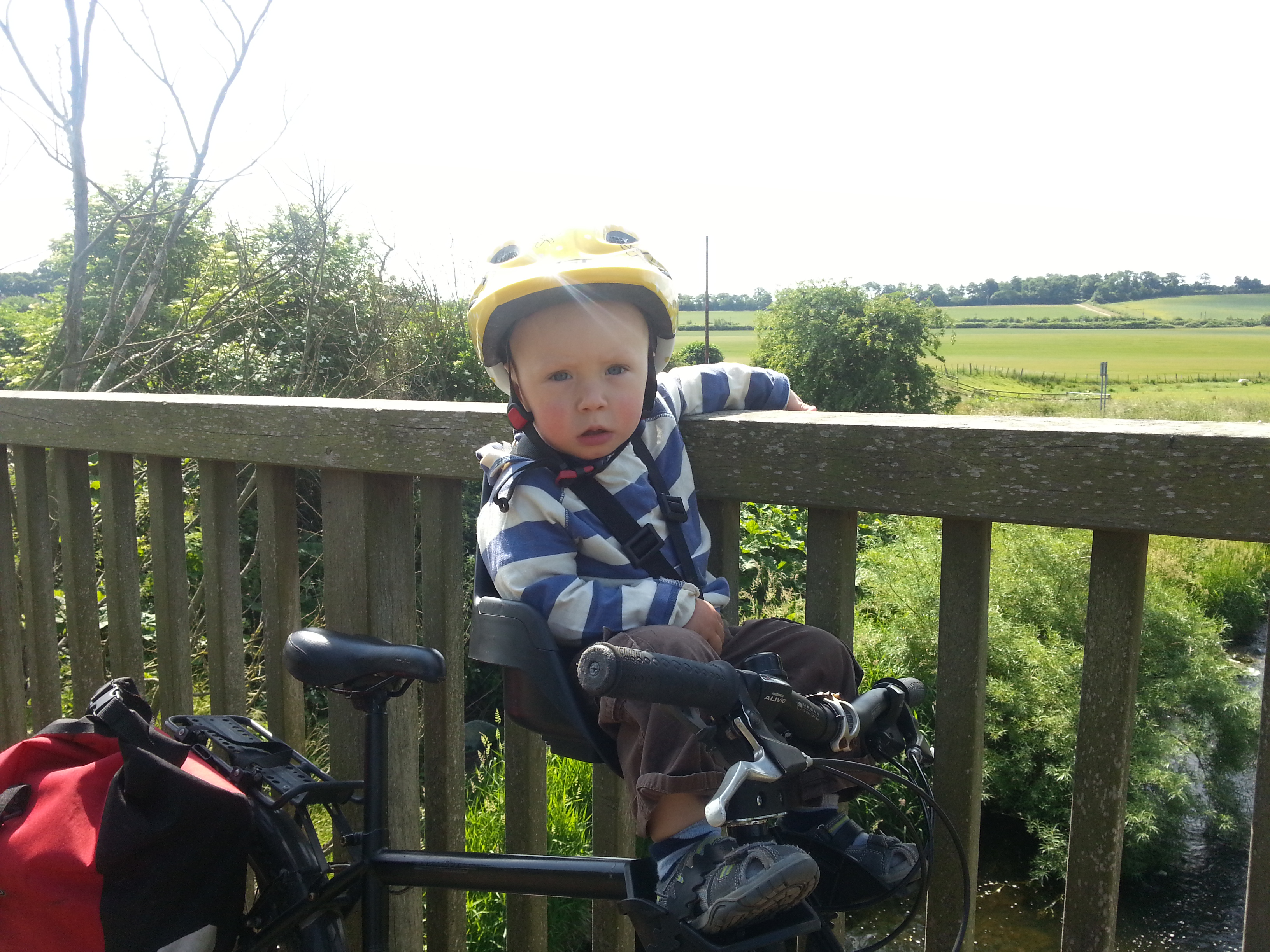
Becoming bilingual(ish)

‘Daddy tissemand?’

‘Yes, Daddy has a tissemand’

‘My tissemand?’

‘Yes, you have a tissemand’

‘Mummy tissekone?’

Yes, Mummy has a tissekone’

‘MUMMY TISSEKONE! MUMMY TISSEKONE!’

Thankfully most people won’t have any idea what this conversation is about within a 30 mile radius of our house, which means having it in the local co-op is just fine. I’m not sure if all toddlers need to re-establish the nature of the genitals belonging to everyone on a daily basis, but ours does and for reasons of modesty I’m glad that this conversation is conducted partially in Danish. This is one of the benefits of bilingualism that I haven’t found in a textbook yet.

When deciding on a husband, the ability to speak another language was high of up on list of desirable characteristics. Like small children, they can make endearing mistakes which enhances the romance just a little longer. My own husband has lived in English speaking countries for 20 years but only last year learned that the phrase ‘when puss comes to show’ is not commonly used and he’d been mishearing ‘when push comes to shove’. See..? So cute!

2014-05-16 15.12.42
Made in Scotland – our Danish/English hybrid

Our first major obstacle in producing a bilingual child was my husband’s inate sense of good manners. Speaking in Danish to our son with me present seemed terrible rude to him, and so was reluctant to use Danish unless they were alone. I tried to resolve this by learning Danish; I managed 6 evening classes last year but was forced to give up when I realised that just learning how to tell the time was going to use the entire portion of my brain that was left over from work. How does a country function when they say it’s ‘half eight’ but really mean it’s 7.30?

We’ve got over this obstacle now and my husband happily chatters away in Danish whilst I (I think) repeat many of the same comments and directions to our son in English:

Can you sit on your bottom please? (Vaer soed at sidde paa din maas.)

You need to be gentle when you stroke the cat/dog/flower. (Du skal vaere naensom naar du tager paa katten/hunden/blomsten.)

Put that knife/chainsaw/box of matches down please. (Vaer soed at laegge den kniv/motorsav/aeske taendstikker ned.)

Would you like some herring? (that’s a lie, I’ve never knowingly offered herring to anyone..)

As a ‘reluctant’ Dane my husband wasn’t particularly bothered about passing his native language on to our offspring. He once told me that no one in Denmark speaks Danish anymore, just English with a Danish accent (this is untrue, many Danes barely have an accent at all). Conveniently for me all our friends had read the same articles in the Guardian I had seen about the intellectual benefits of bilingualism and a campaign commenced to ensure that my husband got down to ‘Operation Dansk’ immediately. I sent off the membership forms to the Scottish-Danish Society and soon we were surrounded by Danes complaining about the state of the Scottish _ (insert almost anything here) and the poor quality stuff we pass off here as marzipan. On a more positive note it’s given us the opportunity to meet other families becoming bilingual and our son the chance to participate in the rituals and festivals that his father did as a child (this mainly involves burning or beating things to death; the Viking genes are clearly alive and well in modern Danes no matter how sophisticated they appear to be).

Animal noises have proved to be an entertaining diversion. I had naively thought that animals around the world spoke English, but it turns out that they don’t. Next time you have dinner with someone who has another language do try to go through the meat selection in animal sounds – I promise it it will be a cross-cultural learning experience..

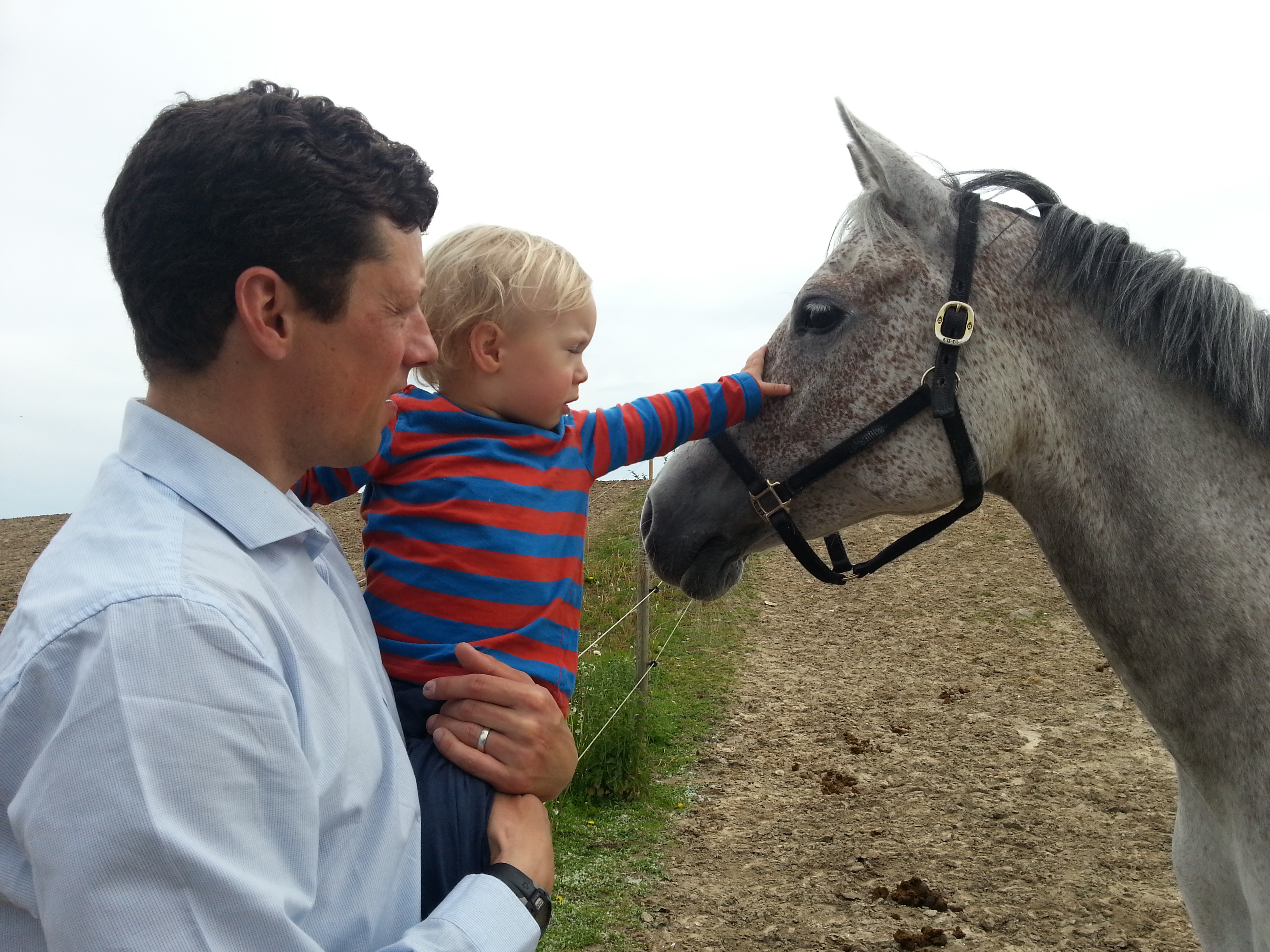
Mummy says 'horse' and Daddy says 'hest'
Mummy says ‘horse’ and Daddy says ‘hest’

Our son delights us every day with his ‘Danglish’, bringing both languages together with toddler babble. From what I understand about the development of language in children this will be a short phase, as he’ll soon work out which words belong to which language and who understands them. For now we’re enjoying this stage as he tries out new words, some more successfully than others. My husband is reluctant to re-introduce the word ‘navle’ (belly button) as our son started using the more endearing ‘nanoo’ when the more traditional pronounceation defeated him early on, as did ‘yoghurt’ which ended up as ‘gu’. Objects of desire stand a much better chance of correct pronounceation, the complex ‘Paaskeaeg’ (easter egg) was learnt with no difficulty as was ‘Appelsin’ (that’s orange in Danish, not a poor job of ‘apple’ in English, as I point out to various shopkeepers in case they think my child can’t tell one fruit from another). When you are two, everything is ‘stor!’ (big) particularly tractor and buses which are conveniently the same in Danish and English.

So, my son and I are both learning some Danish, just not the polite, conversational kind..

Why my family will be pedalling on Parliament

On 26 April you’ll find us on the Meadows in Edinburgh with thousands of others, demonstrating to our politicians that we want to live in a cycle-friendly country.

2014-01-05 10.07.25-1

We aren’t ‘fanatics’ and many of us will have little in common apart from our chosen mode of transport. There will be lycra and helmets, but there will also be flowery dresses, jeans, bicycle baskets and baby trailers (and babies). Quite a few people won’t even have a bike, as Pedal on Parliament is promoting the needs of pedestrians too.

The Pedal on Parliament committee have a detailed manifesto where you can find some sensible arguments about what needs to be done and why. But here is why you’ll find my family in the Meadows on 26 April:

Cycling – it’s good for everyone, even if you don’t cycle yourself.

Cycling is awesome!* It reduces congestion and pollution, it helps you maintain a healthy weight and improves your mental health. It makes you more effective at school, and reduces days off on sick leave. It can bring you freedom, it can even bring you love.

*cycling can also make you follow Americans on Twitter, which can lead to vocabulary irregularities..

Cycling – we can’t afford not to do it

In Scotland teenage girls have frighteningly low levels of physical activity, and apparently ‘overweight’ is becoming the new ‘normal’. Obesity could cost the NHS in Scotland £3 billion by 2030; I’m sure everyone can think of something better we could do with that money. In human terms, that’s 200 lives that are lost each year and families that are unnecessarily bereaved.

If we want to be more Nordic, we need to make some Nordic choices

I’m delighted that, for once in my life, I was ahead of a trend. I fell in love with Denmark over 15 years ago when I fell in love with a Dane. It’s evident that the Danes know something about getting people on bikes (they also think they know everything else, but that’s a different matter) and last summer we cycled round Copenhagen to try out how it feels in cycletopia.

2013-08-05 12.03.06

But cycling in Denmark isn’t restricted to the cities. These are my nieces just outside their house, about an hour or so from Copenhagen.

received_m_mid_1395587884728_23e65f72fc9c512551_0

They choose to cycle because it’s easy, safe and normal. These two beautiful teenage girls travel actively because they have a network of protected cycle lanes that keep them separate from motorised traffic. And where there aren’t protected lanes they share the roads with motorists who also have children that cycle regularly, and are probably regular bike users themselves.

I want my son to have the same freedom as his cousins. I want him to be able to cycle safety to school, to see his friends, to the woods and beyond. But I’m faced with large trucks and no separate cycle path outside our house so I know I’ll be reluctant to let him cycle onto it alone.

2014-04-01 08.40.12

Cycling should mean life, not loss

I don’t want to see any more of these.

2014-03-17 10.50.32-1

These sombre white bicycles each represent a cyclist that has been killed on their bike. They fill me with sorrow, as I know each one represents a grieving family that will be struggling with a loss that had probably been labelled as ‘an accident’. Overall cycling is as safe as walking, mile for mile, apparently. But it often doesn’t feel like that when you have a lorry brushing past you on Princes Street. I can’t protect my son from everything, but I don’t want him to lose his mother because I don’t have protected space on the road when I’m just trying to get to work.

For me, cycling is like love – it’s worth it despite the risks.

If you are a cyclist, or if you love one, please join us on 26 April.

2014-02-16 10.30.52-1


It’s mine, all mine!

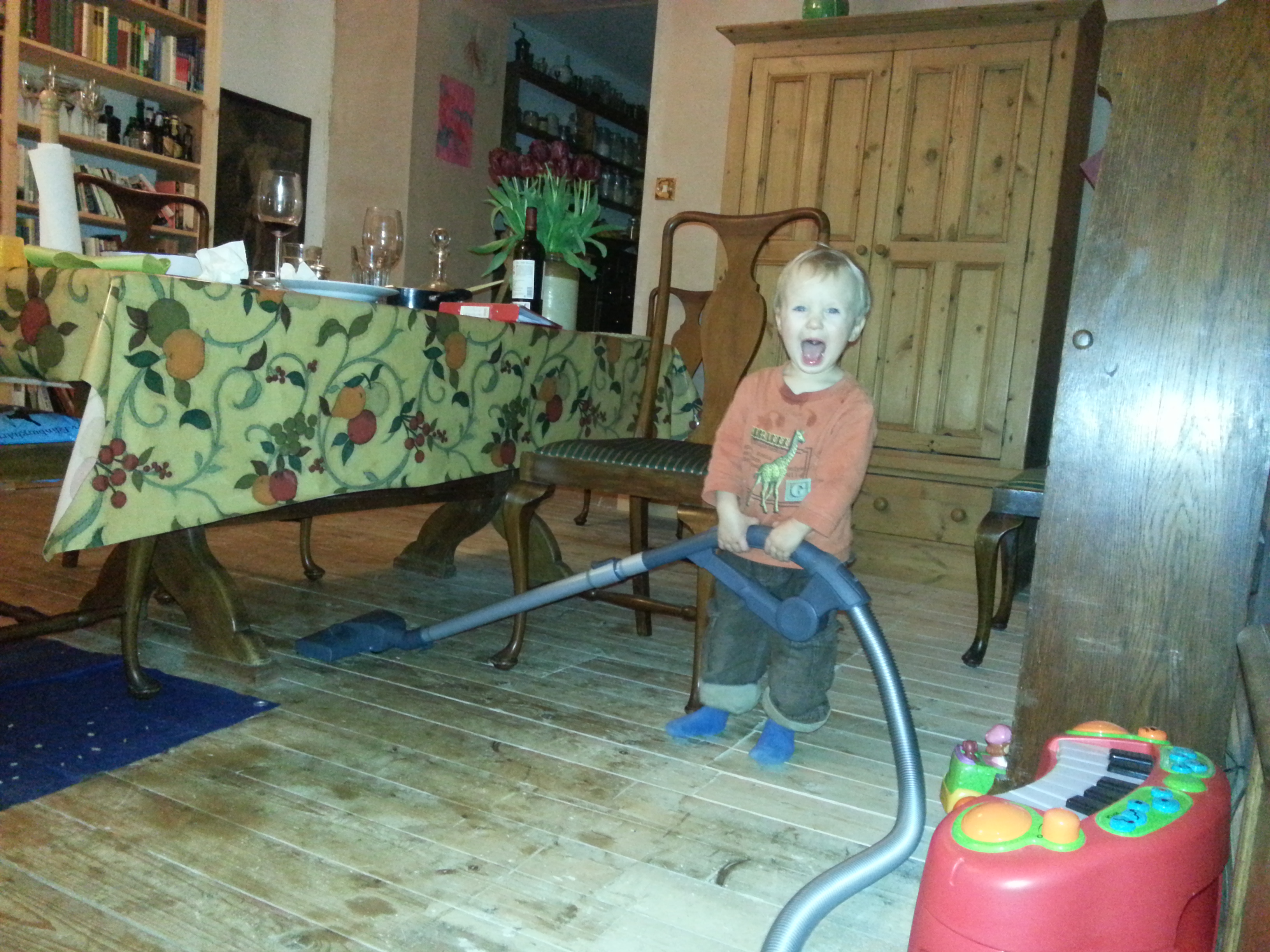
It’s not usually me who runs round the house screaming ‘mine’ and clutching all available objects in reach to my chest. Toddlers are like kleptomaniac dictators, I’ve found. Or at least ours is. I’m regularly told where to ‘seat’ and have to wrestle my possessions from him before they are hidden away in shoes or under the bed. Thankfully he’s so small that he often has to drop something to clutch another object. Toilet rolls, phones, forks, hair clips, table mats, wallets, the laptop and the vacuum cleaner are all highly desirable items in his eyes. Do not leave your handbag in my house; its contents will be riffled and/or water will be poured into it..

2014-02-21 18.53.52
It’s mine! Claiming the vacuum cleaner..

By default my beloved bike has been claimed as ‘mine’ by my son too. With two fixings for toddler seats, the back one requiring the removal of my pannier rack, it’s showing the same signs of possession as my post-pregnancy stomach and our Lego encrusted house.

2014-02-16 10.38.20-1
This is mine too… all cosy on Mummy’s bike..

It’s now a toddler carrying device, not my adventure loving bicycle. It’s not a complaint; I love most of the changes that remind me that our lives have been turned upside down by our furiously energetic little boy. But I have found it hard at times to adjust to being a parent; it’s an all-consuming role that reaches every part of your life – everything now has a little handprint on it, from my working life to my relationships and my own body. Nothing is just ‘mine’ anymore, just as I’m no longer ‘me’ but ‘us’. For someone who has spent most of her life fleeing from commitment, this has been quite a journey of self discovery.

2014-02-16 10.30.52-1
‘Us’ – on four wheels with six feet..

I’m an anxious, anally retentive stress merchant so the need to gain control over some of my life again has been necessary. Tattoos, radical haircuts and inappropriate dancing with unwholesome people wasn’t appealing. So I did the only thing that I know leads to supreme joy; I bought a new bike.

2014-02-28 14.20.29-1
The new love in my life..

It’s a Dawes Galaxy (20 year old frame with refurbished parts..) from Common Wheel, a mental health/bike recycling charity in Glasgow. It’s been well used, and is a little battered, rather like me, but it’s beautiful. And it’s all mine.

2014-03-01 09.46.25
Mine.. all mine!

Let the train take the strain?

When I’m forced awake in the morning by either of my alarm clocks (for the record, I do prefer the one that shouts ‘Mummy! Up! Up!’) my mind immediately runs through the childcare/transport options that have been carefully agreed with the Husband and the local train station in previous days. If the toddler alarms wake me up and the Husband is still there it means something has gone wrong in this elaborate plan, or it’s the weekend.

Why this masterplan? Well, there are a couple of reasons. Firstly, where we are (Dunbar, on the east coast of Scotland) you can’t just put your bike on the train and go. No. That sort of spontaneous behaviour is forbidden. Unless you get a specific train, which allows spontaneous behaviour in only one person wanting to travel with a bike. The other two people have to book ahead or risk Train Conductor Wrath. Or hope that the spontaneous cyclist missed the train. All other trains require organised cyclists or ones that have the emotional energy to beg and enough time to lock their bike to something if the answer is ‘No’.

Confused? You should be. All train companies operate different bicycle carriage options and it’s up to you, the bicycle user, to find out what they are.

2013-07-04 16.40.27
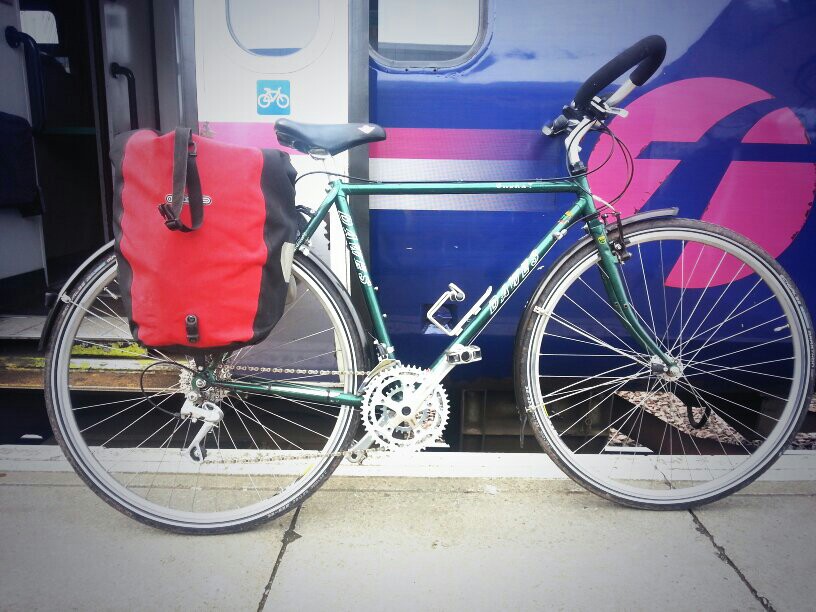
My bike all happy with ScotRail

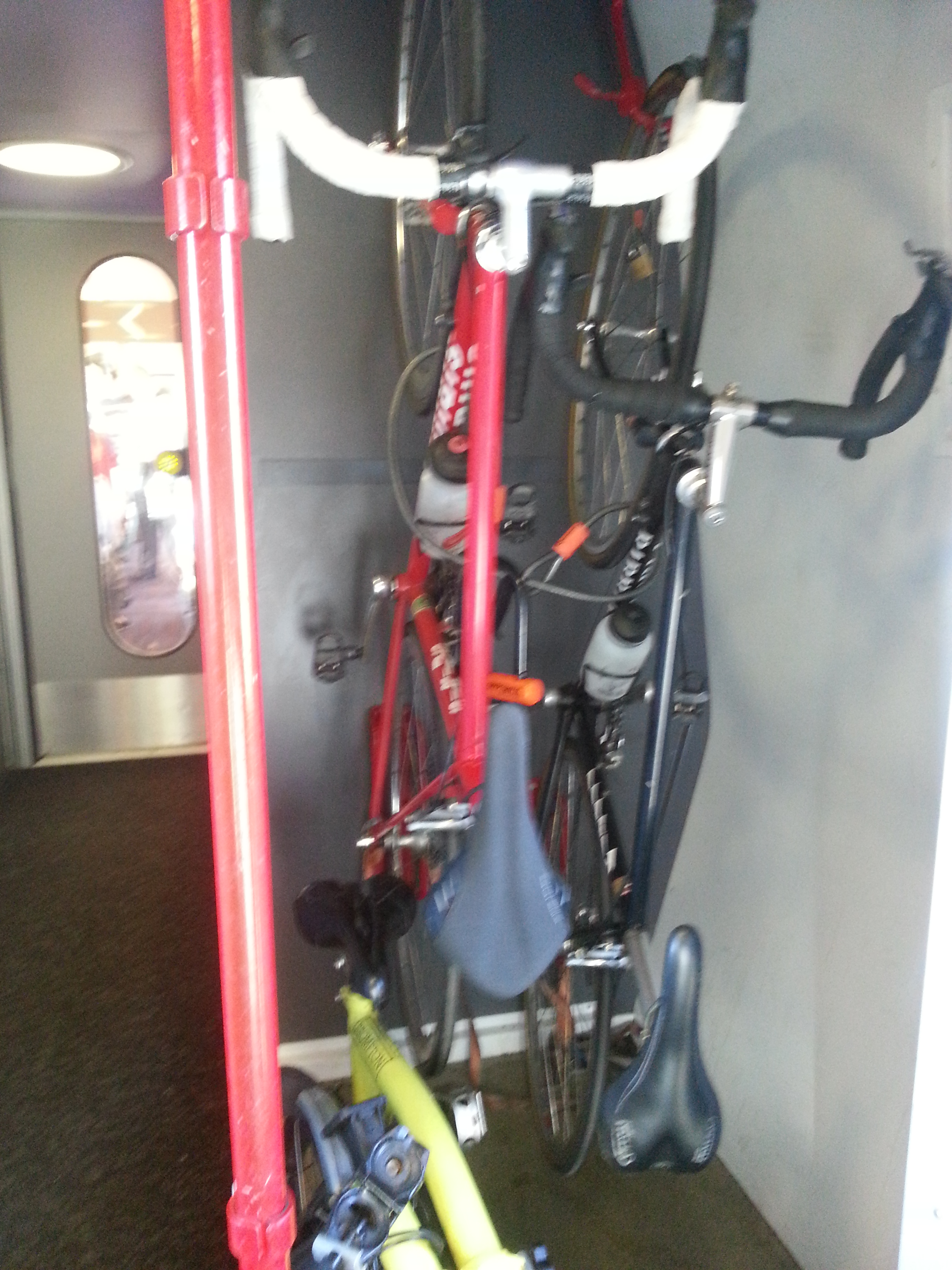
I’m a regular user of the train – with and without my bike and child – as my job involves travel throughout Scotland. Often, however, I’m just trying to travel the 30 miles to my office base in Edinburgh. Our local station, Dunbar, hosts three different train companies: East Coast, ScotRail and CrossCountry. If I want to travel with my bike and I haven’t booked I need to get the 7am train, which is run by CrossCountry, as it allows one spontaneous cyclist and two organised ones. Dunbar has quite a few cyclists, organised and otherwise. Some mornings we recklessly break all the rules and cram four or more (plus a Brompton) bikes into the bike racks and (empty) storage area. That’s when we get Train Conductor Wrath, which is the closest I’ve ever got to being told off by the Headmaster (I was Head Girl at my school, don’t you know). It’s quite thrilling as long as I’m not ‘the fourth cyclist’…

2013-09-04 17.23.45
See – full here and in the other one. At least I’m developing my arm muscles..

The 7.43 train is East Coast, who do not let unbooked bicycles onto their train, unless it is at the express permission of the guard. I usually lack the emotional energy to beg the East Coast train guard to let my unbooked bicycle into his special place so if I get this one I either walk for 35 mins each side of the train journey or take the ruinously expensive bus (I’ve already paid £11.80 for the train and am seething about this already). Live closer to work? Not if I want to work for a charity and have a garden that I can swing the toddler in… besides, sometimes I have to compromise with the Husband and he wanted to live closer to trees and away from other people.

Shall we bring in childcare now? My son’s nursery opens at 8am, so the 7.43 train isn’t an option if it’s one of my ‘drop off’ days. The next train is at 8.56. WHY? WHY? WHY? This makes no sense to me. Why not 8.15? I’m sure there are many splendid reasons why this can’t be done, but as this blog is all about me I’m fixated on how bizarre this is, given that most people wanting to get a train from Dunbar probably want to go to work in Edinburgh at around 9am. We are on the east coast main line, so the 8.56 is coming from Doncaster and obviously none of those people want to arrive in Edinburgh for a 9am meeting either.

Oh, and the 8.56 is East Coast too, so unless I’ve booked my bike on the day before I’m back to the walk/bus options that I don’t have the time or money for. This is when I see our little Honda Civic waving at me from the street, wanting me to become part of the congestion problem in Edinburgh..

On the way home I have a similar routine. The gloriously spontaneous 4.33 is ScotRail and not bookable. I’m fairly sure all their inspectors have been on some sort of ‘loving the cyclist’ course as even when the two bikes per carriage rule is broken they invariably don’t mention it. Unlike some other train users who have a selection of dirty looks for infringers. Unfortunately it’s a rare day that I can leave the office at this hour.

2013-11-20 16.31.44
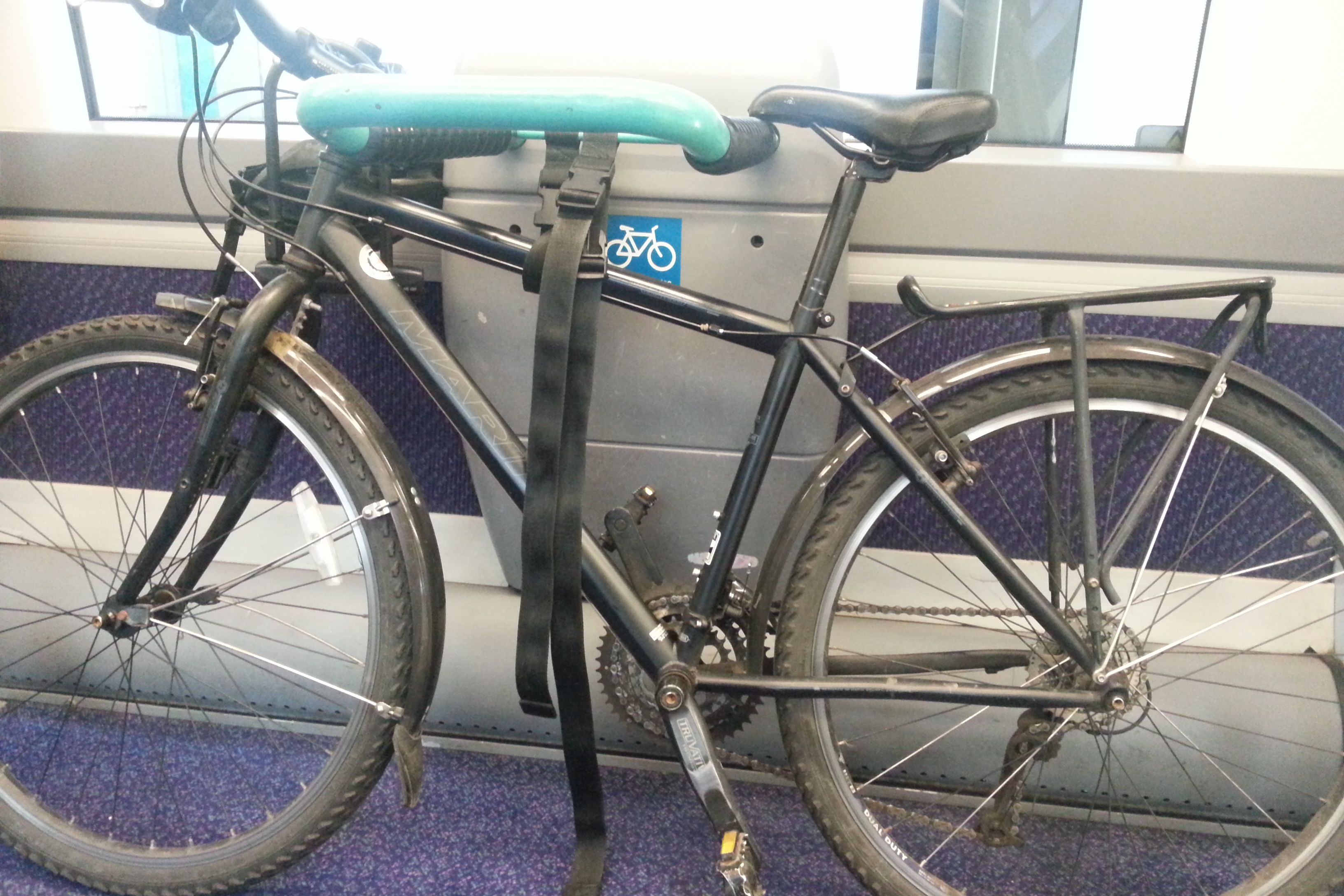
The 4.33 from Edinburgh – all full

The 5.08 is my train of choice as it’s CrossCountry and therefore available to the disorganised cyclist who has to get back home to pick up a toddler from nursery before 6pm. The 5.31 is an East Coast, going to London so is invariably packed full of angry people shouting at bewildered people without reservations. If this is the option for the day I lock the bike up at the station and try to hide somewhere onboard or wait for the 18.05 and risk dinner being delayed (hungry, screaming toddler) or already eaten.

2013-09-07 18.38.22
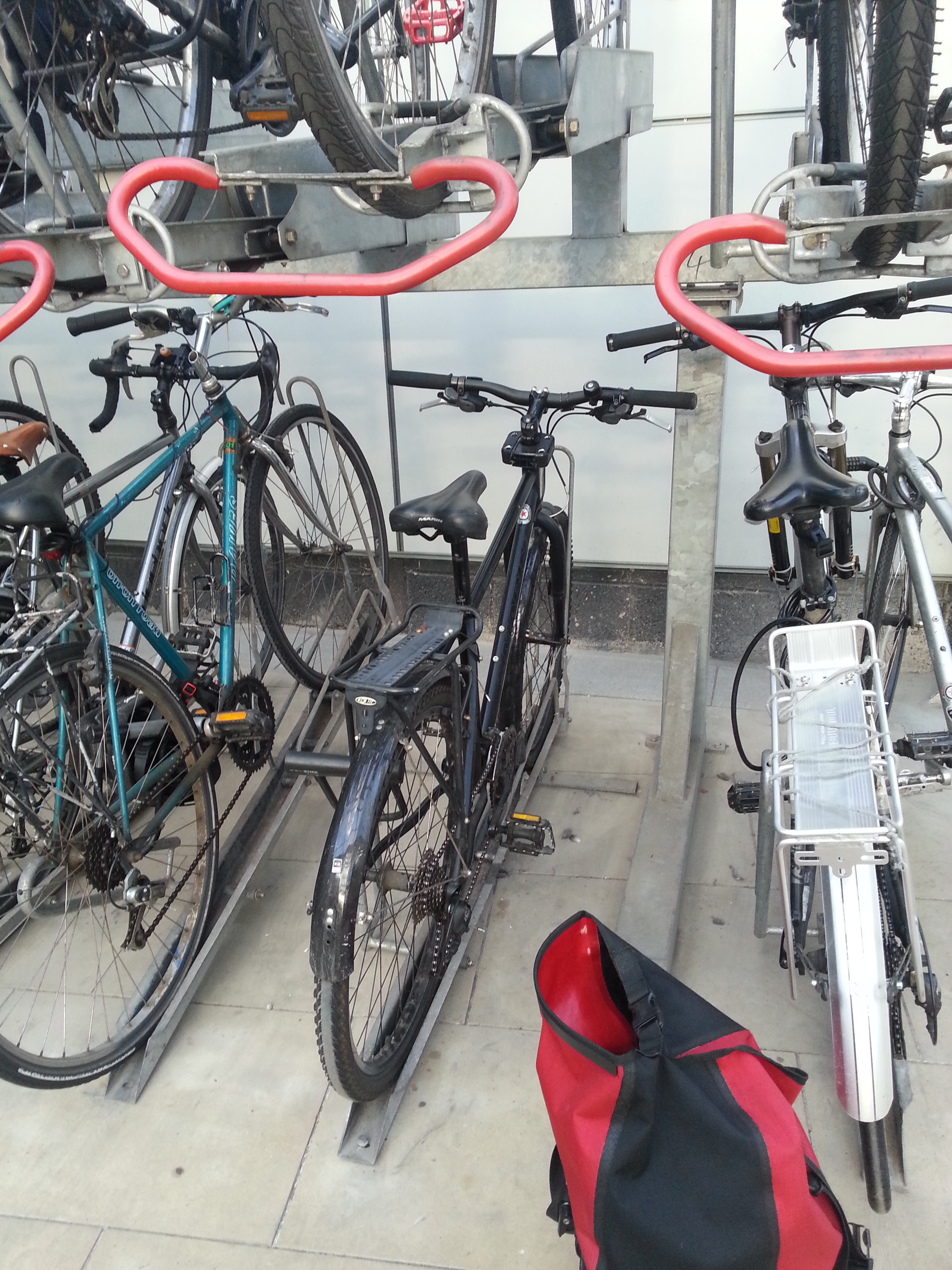
Part of the cycle parking at Edinburgh Waverley – that’s full too usually…

Combining child, bike and train maximises the issues already mentioned and adds a new one: how to get the combined bike and child onto the train? I’m not a feeble or miniature woman, yet I find it quite a challenge to get my hybrid off the platform and through the narrow carriage door when it’s unhampered by a 12kg toddler (I had the baby seat attached to the bike this morning and one of my lovely Dunbar cycle gang had to help me get it hooked up). Add the toddler and it’s impossible to lift. Other people’s children may stand still when required but mine doesn’t do this yet and I’m not sure I want to test his reliability by the side of a train track. So far we have relied on kind strangers to help us alight, but I just don’t think it should be this hard.

2013-08-30 12.56.06-1
On a train in Glasgow – just couldn’t do it!
2014-01-14 06.53.57
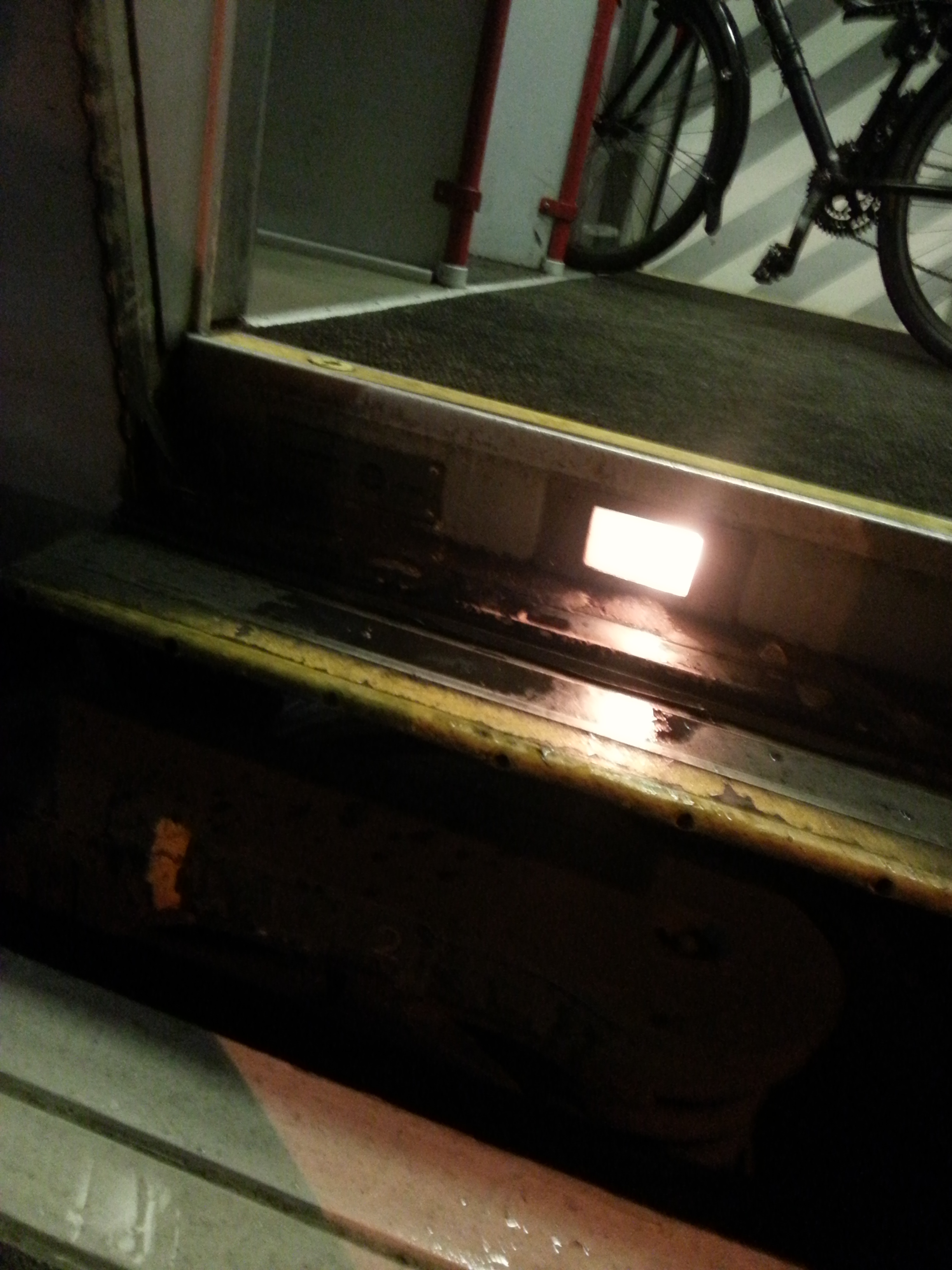
A small step for man? I find it quite hard..

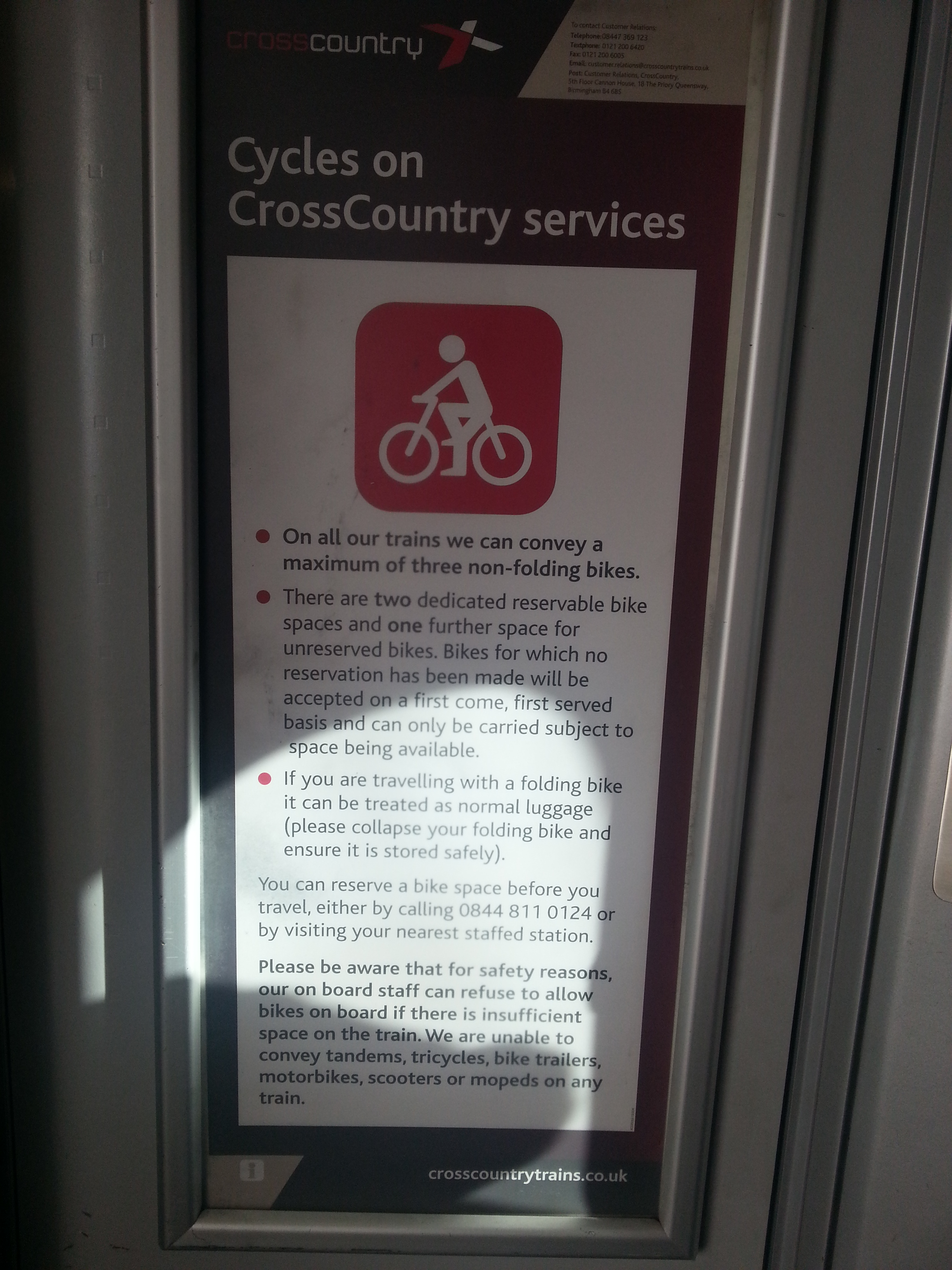
Did I mention that bike trailers aren’t allowed on CrossCountry? It’s just another frustration to add to the list. If someone can bring a 20kg suitcase and block the aisle I don’t see why I can’t bring our packable trailer. And 2 or 3 bikes per train – it hardly encourages sustainable, integrated transport does it? My family will use the entire allocation when my son has a bike. If he had a sibling, should we leave one of them at home? Isn’t travelling sustainably what we’re all supposed to be doing?

2013-08-14 17.28.08-1
CrossCountry reminding you they want really don’t want you.. or your trailer..

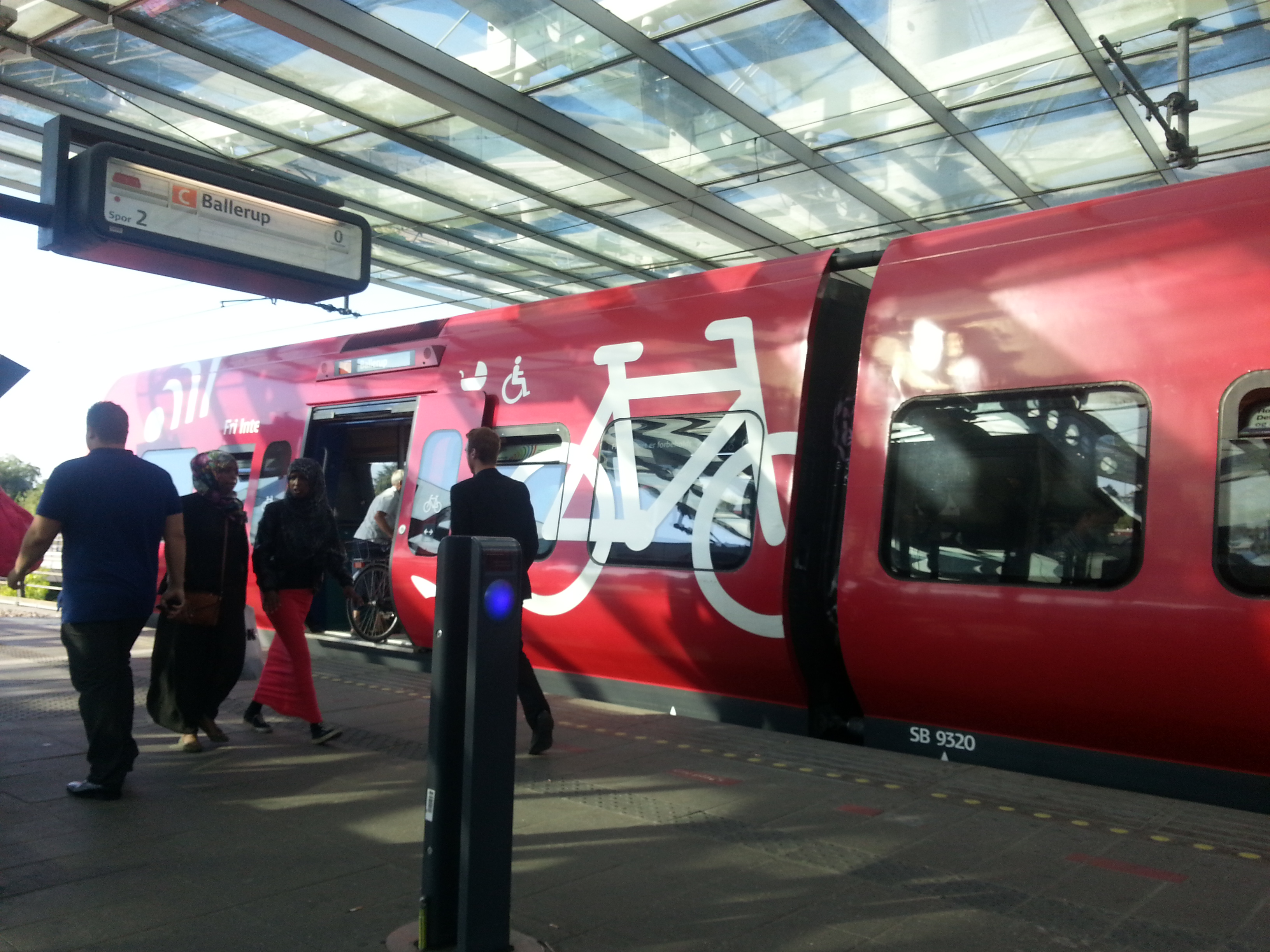
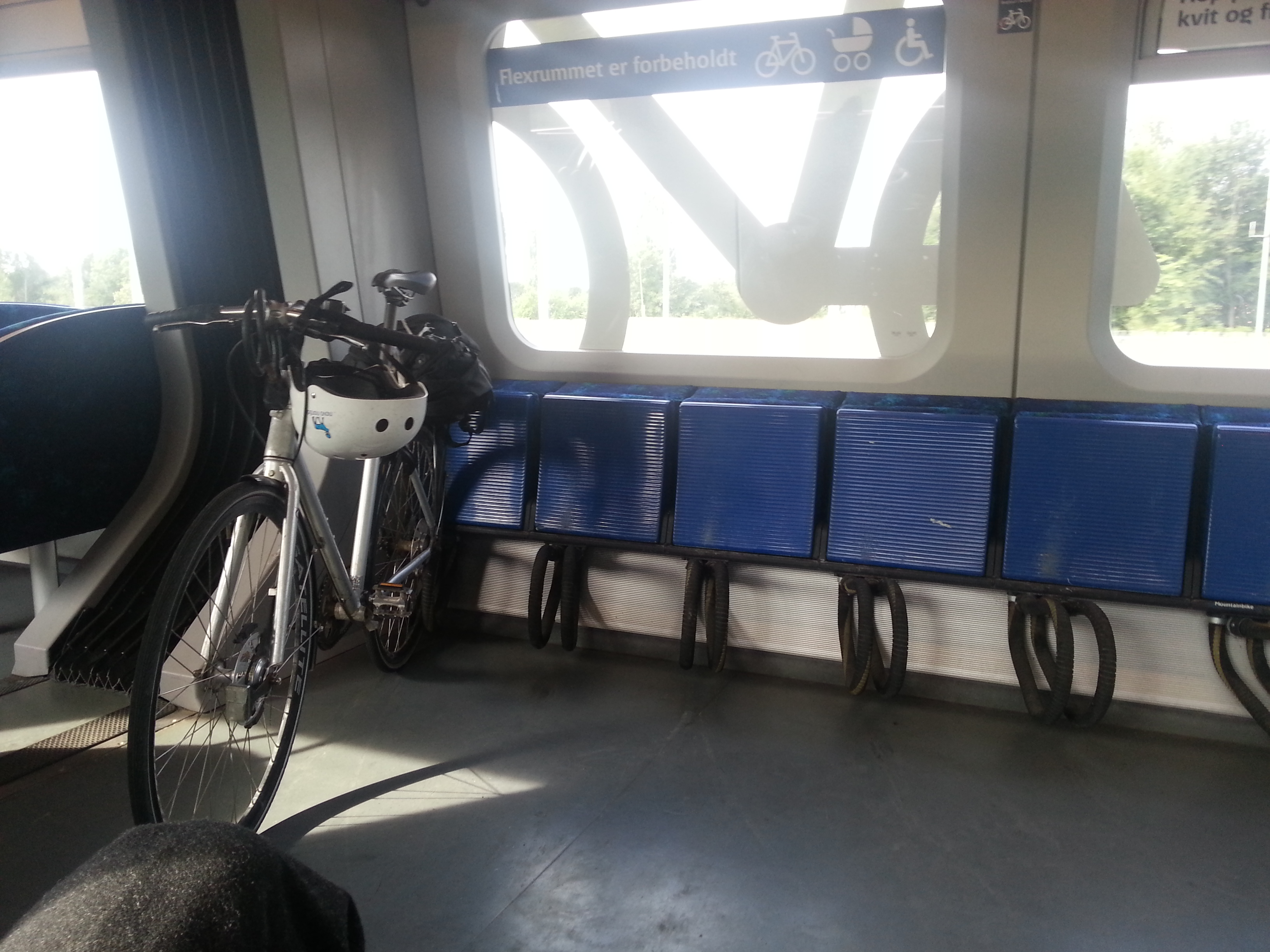
Last summer we visited the Husband’s relatives in Denmark and I got my long desired day of cycling in Copenhagen. Not only do they have superb cycle infrastructure on the roads, they have trains that work with bikes too.

2013-08-05 17.49.43
The bike loving trains of Copenhagen

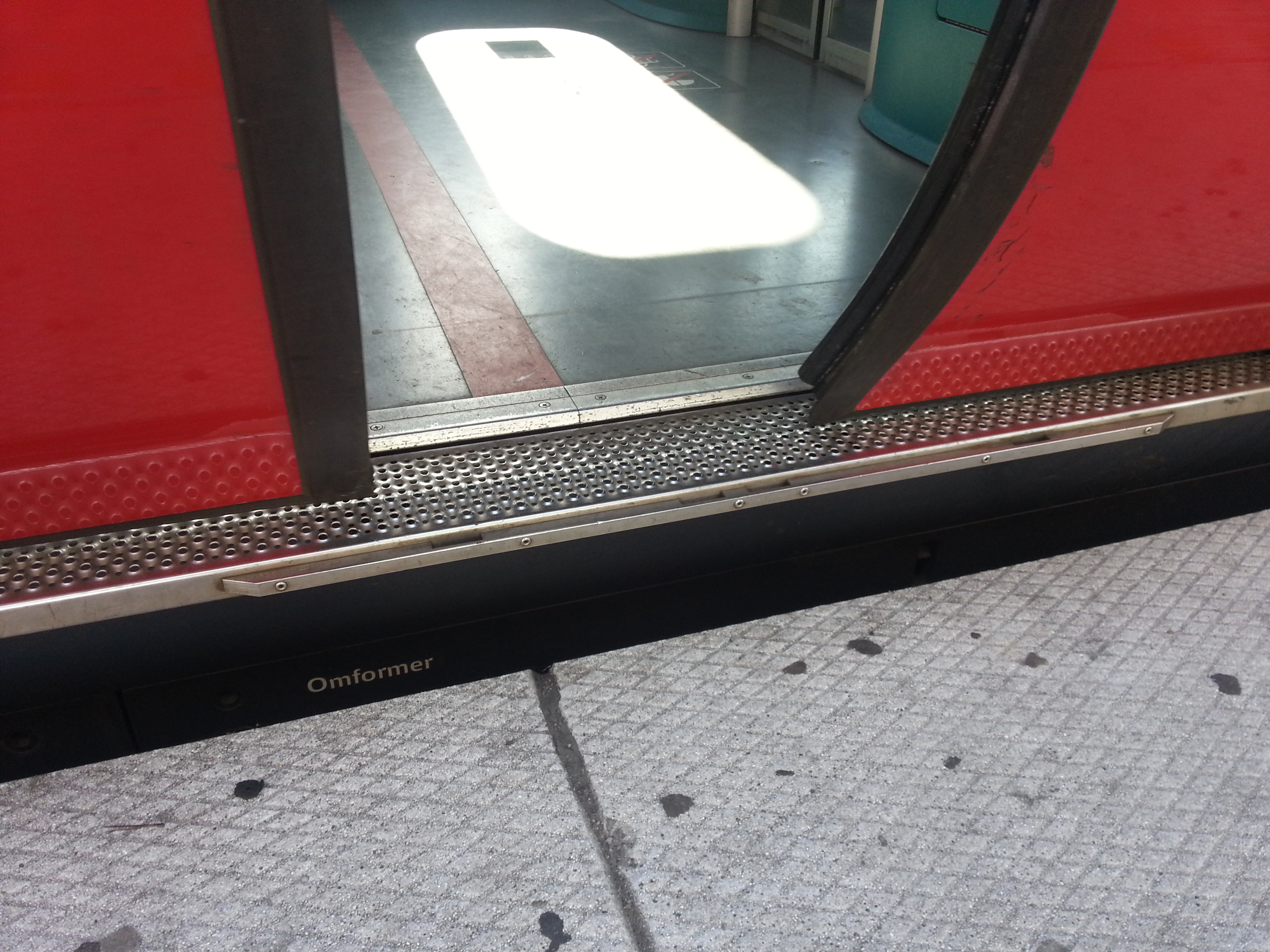
Whilst taking some photos of the easy access doors and platforms the Husband had to explain to a ‘fascinated’ local that in Scotland it’s hard to get your bike on the train.

2013-08-07 16.49.32
Tiny little step that even I can overcome!
2013-08-05 09.17.05
Real space for cycling..

Every train we went on had a dedicated carriage for bikes. Yes, an actual entire carriage. At one point I counted 14 bikes and two pushchairs. I wanted to take photos but I thought the Husband was probably sick of explaining me..

Four bicycles and a scrounger..

The festive season is upon us and Father Christmas is going to be performing miracles soon by putting inconveniently shaped bicycles down a whole load of chimneys. Unfortunately he won’t be visiting me this year so I thought I’d write of bicycles past and the people that helped me pedal them..

So, follow me back to a scary place – suburban Surrey of the early 1980’s…

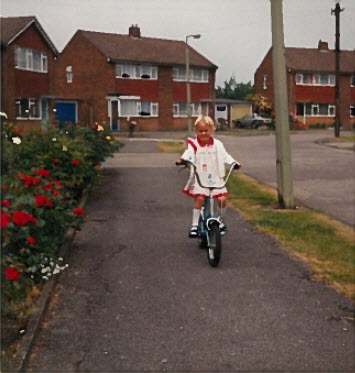
Here is my sister, displaying the cycle chic of the time. Our dad taught us to ride a bike. It was a Raleigh Budgie and, having just looked at the prices on Ebay, I now wish we’d kept it. I don’t remember much about cycling then apart from a faint memory of the thrill of riding without stabilisers. My main aim in life at that time was to be a professional footballer and I think my sister and I were both fully preoccupied with lobbying for a ZX Spectrum Plus (which we got) and a kitten (which we didn’t get).

suzanne on bike maybe

Cycling wasn’t really part of the culture of our bit of suburban Surrey. Not that there was much culture of other types either. My friend Esther had the only cultured parents I knew; they listened to Radio 3 and read the Guardian, which was unimaginably intellectual behaviour in our Daily Mail reading household. My mother cycled when my sister and I were small, but abandoned it when she learnt to drive. My parents encouraged me to learn to drive and bought me a car – a greatly beloved Datsun I called Gabriel, but it was older than me and cost £250 (before anyone suggests that Surrey is entirely covered in Range Rovers and stockbrokers). I did my cycling proficiency at middle school but clearly failed to grasp the point of the whole operation, as all I remember was the pleasure of escaping maths for a few mornings.

By the time I reached 23 I’d been through university, met plenty of people who rode bikes but not considered it as something I needed or wanted to do. Edinburgh was a walkable city, I was never in a particular hurry to get anywhere and the bus system was affordable.

At 24 I found myself back in the suburbs of South London, with a minuscule part-time salary and a cycle commuter boyfriend. Keen to share the cycle love, he bought me a bike – a Halfords Apollo – so I could cycle the few miles to work. It was a heavy mountain bike, not entirely suited to the role but it did the job and I started to think of myself as ‘a cyclist’. Yet somehow that bike fell into disuse; too heavy for my new 16 mile a day commute, it languished into a rusting heap in the back garden whilst I took the train. Something similar happened to the boyfriend.

I’m now forced to reflect on my scrounging ways as my next bike was also a gift. Enter my cousin Isobel and her unused, but perfectly kept, Raleigh ladies bike. The Raleigh gave me new cycle life, doing my, now shorter, commute with ease.

Then, nearly 10 years ago now, I met someone who didn’t give me a bike. He taught me to love the bike I had (someone should write a song about this).

Mark lived adjacent to the estate where I worked as a community development worker. Under the pretext of starting a cycling club together, Pollards Hill Cyclists, he showed me routes into central London through parks and low traffic streets. Mark took me through green spaces a few miles from my home that I’d never encountered before, he introduced me to the pleasure of riding in a group and the joy of feeling tired and mud splattered after a day riding in the autumn rain.

CIMG1177
A Pollards Hill Cyclists adventure with Mark in the front
Pollards Hill Cyclists 5th Birthday Ride

Mark showed me the joy and ease of cycling. I saw how it made life less complicated than using TfLs journey planner, how the purchase of a decent waterproof jacket could immeasurably improve your day and that it was acceptable (encouraged, even) to eat all the cake if you did 30 miles before or afterwards.

For the first time in my life, for my 30th birthday, I parted with my own cash to buy a bike.

CIMG1811
Packed and ready for Arran

It took me nearly 25 years from learning to cycle, to really loving to ride and it had nothing to do with being bought a bike, just some time and care to show me where and how to ride it. Merry Christmas.

DSCF0114
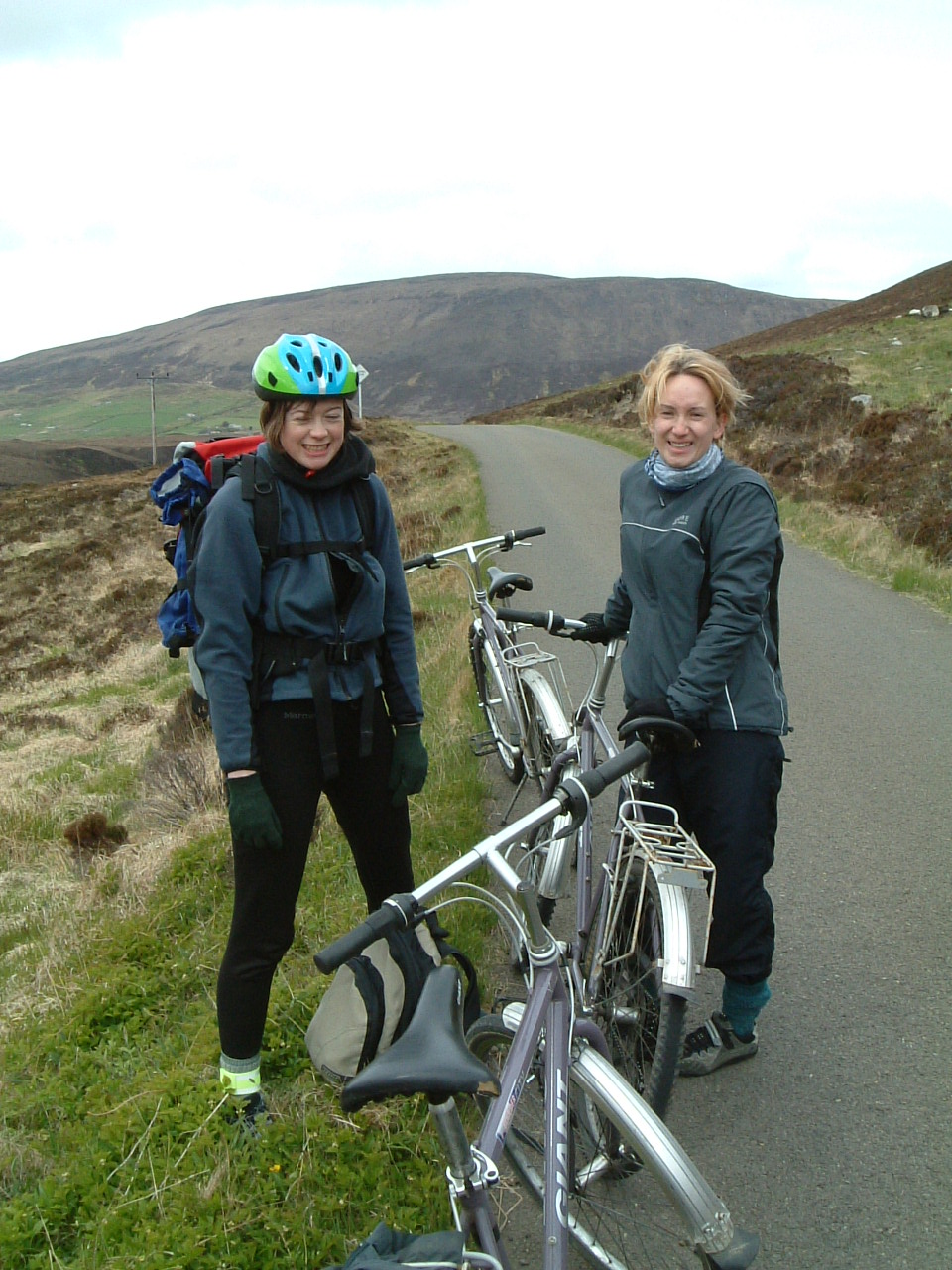
Cycling in Orkney
1586836294
Passports ready for Panama..

The fundamental importance of snacks.. and other observations on family cycling

Since I started to cycle with my toddler I’ve learnt a lot, mainly through the medium of making mistakes. This is a brief overview of how to avoid the worst of them..

The equipment
Getting your child onto the bike is the first task. Gaffer tape was suggested to me, but in the end I decided that a baby seat was probably the better option. In a fit of localism and sleep deprivation I did no research and went to the local bike shop and bought their suggestion – a Dutch Bobike front seat. This has been a partial success. I love the ‘front’ aspect as he feel safe and secure between my arms, I know what he’s doing and we can chat away while we ride. We tried a rear mounted seat in Copenhagen this summer and he saw nothing of the city because pulling my cardigan over his head proved to be more fun.

2013-11-25 09.34.31
The front mounted Bobike
2013-08-07 12.12.28
Snacking in Copenhagen

Continue reading “The fundamental importance of snacks.. and other observations on family cycling”

From incubator to bike trailer

Part 1: Our son arrives early..

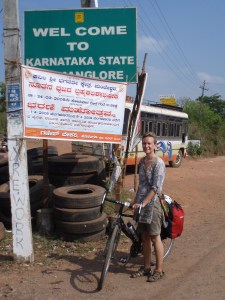
This is me in India, nearing the end of a two month cycle trip. At that time I couldn’t imagine not cycling for miles every day; touring, commuting, to the shops, the cinema. I was ‘a cyclist’; a cyclist that couldn’t understand why everyone else wasn’t. And I wasn’t sure why we needed cycle lanes either.
OLYMPUS DIGITAL CAMERA

Just over 3 years later I became pregnant, after 16 sad and painful months of not being pregnant. I was delighted and terrified in equal measure, knowing a fragile new life was inside me. I looked again with different eyes at the Edinburgh streets packed with cars and stopped cycling. I also didn’t drink alcohol, eat undercooked red meat, goats cheese or uncooked eggs. I ate more fruit and vegetables than was probably wise. I walked daily, in moderation, and even thought about pregnancy swimming and yoga (yes, I thought about it, I confess I didn’t actually do it). I could have been a cover girl for the NHS ‘Ready Steady Baby’ book. If there was a guideline, I followed it.

My pregnancy was perfectly normal and I felt fine, tired but ‘fine’. My husband and I did what lots of expectant parents do, we bought a house that needed extensive building work, where we knew no-one and had never even been before we viewed the house. I think the nesting instinct gets increasingly out of control the longer you leave parenthood.

My maternity leave was arranged, my cover sorted with a month handover. My boss and I were very pleased at how organised we were.

And then our son arrived 9 weeks early.

Everything explodes when you have a premature baby. If, like us, there is little or no warning, you are the exact definition of not prepared. No baby clothes, no birth plan, no nappies, no idea what has happened to you..

The NHS has my undying devotion for how it helped us through that night, and the weeks that followed.

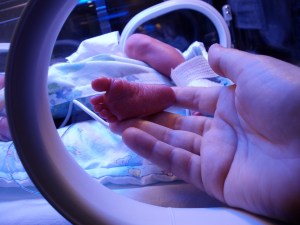
The night he arrived was the most scared I have ever been. The fear that he’d not be ‘ready enough’ to live was almost overwhelming. Like many premature babies he was in a rush to arrive and he was born less than 6 hours after my waters broke. He weighed 3Ibs 10oz and was taken straight to the Neonatal Unit wrapped in a plastic bag. I read in our medical file later that he wasn’t breathing. Like most babies of his gestation he needed a CPAP machine to support his breathing and to be under a blue light to keep the (potentially dangerous) bilirubin levels under control. I wasn’t able to hold him until he was three days old.

 OLYMPUS DIGITAL CAMERAOLYMPUS DIGITAL CAMERA

For the first few weeks we were only able to hold him for a short period of time each day as his body temperature had to be kept stable. We learnt to feed him a few millilitres of my milk with a syringe connected to a tube in his nose. Every gram he put on felt like a significant step.

He didn’t seem tiny to us then, he looked perfect in every way. We look at the photos now and can’t remember him being that small, or at least we only remember it in fragments or in a particular moment. Parenthood alters your perception in every way, so perhaps it alters your vision and memory too.

OLYMPUS DIGITAL CAMERAOLYMPUS DIGITAL CAMERA

A premature baby requires some complex coordination and planning: getting to and from the hospital, expressing and freezing breast milk every 4 hours, learning how to change miniature nappies inside a plastic box, learning not to become hysterical when the alarms and flashing lights attached to your child go off.

The Bliss booklet we were given was a great help, with lots of useful information to help us judge how our son was progressing. But the section ‘Saying goodbye to your baby’ made my stomach turn; how can any parent prepare for the death of their child?

The NHS was magnificent and provided us with the tools we needed to care for our tiny baby; the calm, professional, caring support gave us the balance between being prepared for challenges but hoping for the best.

OLYMPUS DIGITAL CAMERAOur son spent five weeks in hospital, first in a covered incubator then in an open cot as he grew and became more stable. Each night I had to leave him, fearing that he’d cry out in the night for me.

He wasn’t quite 5Ibs when we took him home – we turned up the heating in our partly built house and settled down.

We stayed in lock down mode at home for the recommended 6 months, for fear of coughs and colds or worse setting back our son’s progress. Only friends in the best of health were allowed to visit. I fled the greengrocers if someone sneezed.

When I became a parent I stopped being who I was, I became the parent of a premature baby. Everything was different for us, the ‘normal baby’ rules didn’t apply and I couldn’t imagine a time when I’d not say ‘but he was two months early’ every time someone asked how old he was. I washed my hands like a heart surgeon for months after we left hospital; contact dermatitis made my hands look like I felt.

A friend offered me a baby bike seat, which I rejected, horrified, as if she’d offered me a tiger. I couldn’t imagine ever cycling again.

Part 2: Back on my bike

It has taken well over a year for the fear and anxiety to start to lift. Our son has thrived and we’ve been incredibly lucky. My husband and I are not religious, but this experience has made us feel like someone/thing should be thanked for our good fortune. In a different time or place we might have experienced a very different outcome. We know that some babies leave a neonatal unit with many more months of hospital care ahead of them. And some don’t leave at all. Shortly after we came home with our son there was an outbreak of Pseudomonas aeruginosa bacterium in the neonatal unit in Belfast and three babies died.

At the start of this year I noticed some posters around town for the Dunbar Cycling Group, advertising family rides through the spring and summer. This was exactly what I needed to get me back on my bike, and cycling with my son.

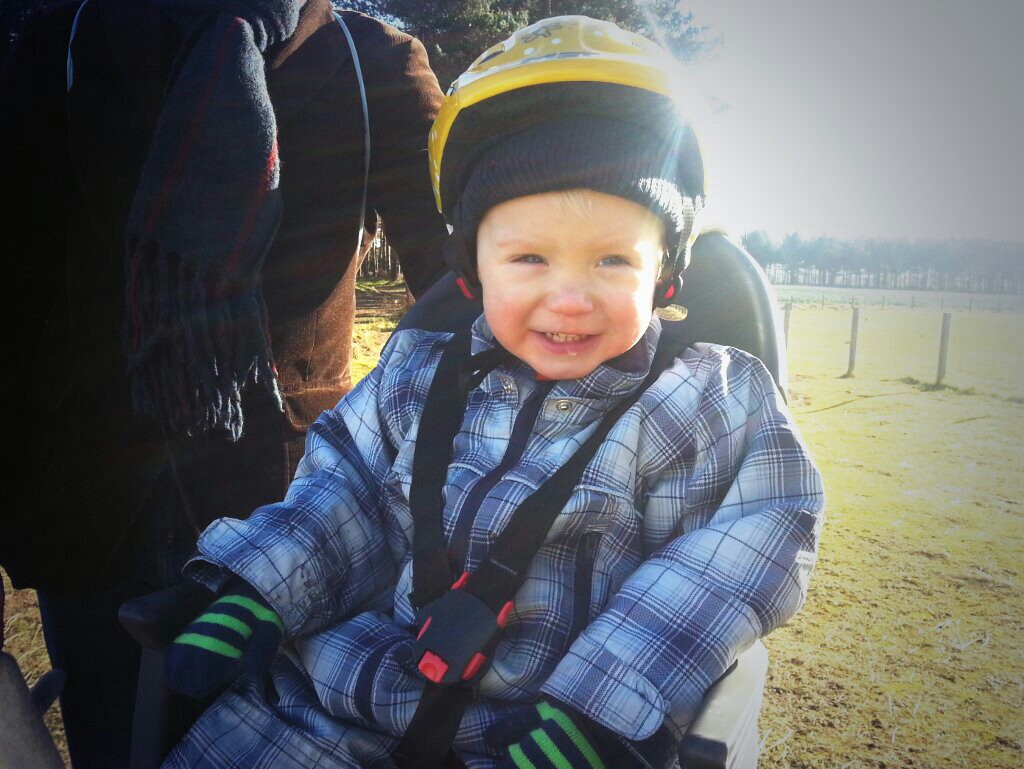
We went out for our first ride in April and haven’t looked back. We’ve ridden regularly with the group, gaining confidence in the crowd of other families. I’ve learnt to handle a bike, bag and baby so that the baby doesn’t fall to the ground, although I still can’t get us on a train without asking for assistance. My son loves being on the bike (for an hour or so, he’s not keen to stay still for long..) and our baby seat is on the front so I can talk to him as we ride. Primarily he enjoys pointing out the animals on our rural rides around East Lothian, although at the moment he’s under the impression they all make a similar noise – a cross between a sheep and dinosaur – which can be quite startling if I haven’t spotted them first. He also seems to find the whole experience quite relaxing so he often has a nap..

2013-04-20 10.58.15 2013-07-07 11.01.58

Becoming a parent has changed my view of cycling, and of the way I want to use the roads. I no longer want to fight for space with cars, I want my own cycle space away from the cars. I don’t want poor infrastructure that ends abruptly, spewing us out into the road. I  want to feel safe for the whole length of our journey, knowing that car drivers won’t be trying to squeeze by, brushing my son’s little feet.

We need to equalise the power on the roads by giving bikes, cars and pedestrians their own space. I’m no urbanist or infrastructure expert, but as a parent I know now you won’t get the cycling modal share that Amsterdam and Copenhagen have without their commitment to high quality infrastructure. There are lots of other barriers to cycling – confidence, health, culture, knowledge, money, the weather – but safety is the key.

Our family holiday to Denmark was a perfect lesson in how to create and maintain a cycle culture where everyone feels safe on a bike. The biggest threats I felt was from tourists who stumbled into the cycle lanes and from other cyclists who weren’t impressed by my leisurely pace.

2013-08-07 12.12.282013-08-07 13.30.54

My son regards sitting still (and sleep) as the enemy so we’ve never covered more than 20 miles together in one go, but as I thought we’d never leave the house at one point, this is a huge achievement.

We’ve bought a bike trailer for longer rides in gruesome weather and a balance bike is wrapped ready for his birthday this week. Even my husband has been tempted out on his (neglected) bike with us. It might have taken me a while to get from incubator to bike trailer, but I’m delighted to finally be a #cyclingfamily.

Finally, in case I never get to give a Nobel speech..

Friends, colleagues and family have been been a huge support in the last two years, but I want to thank the following in particular:

The midwife who was with us throughout my labour, who was so kind to us in our terrified and traumatised state. I’m so sorry that I don’t remember her name.

All the neonatal nurses at Edinburgh Royal Infirmary, who cared for our son 24 hours a day. Their kindness and professionalism reassured us that he was getting the best possible care, which allowed us to go home at night and sleep.

Magda, our neonatal paediatrician and Hilary, our neonatal physiotherapist, have been a huge support over the last two years. They’ve always had time to discuss our concerns and have made us feel like people, not an NHS number. In January we will say goodbye to them, as we’ll be signed off from the prematurity service. We’ll never forget them.

Within days of our son’s birth we enrolled in a epigenetic study, lead by Dr Chinthika Piyasena, looking at the long-term health outcomes of premature children. Chinthika provided great help, advice and good fun, as well as giving us the opportunity to ‘give something back’ through her research.

Our local Lloyds pharmacy in Dunbar has helped us with every cough, cold and ear infection with genuine concern and care. Similarly, the Harbour Medical Centre staff have been superb, responding to our every phone call with calm compassion and sensible advice.

My friend Jane, who has walked with me through every joy and sorrow in my life since we were 8 years old. For everything you’ve done, ‘thank you’ is never enough.

My husband has been my steadfast support throughout. He took a 3 month share of our parental leave, allowing me to go back to work and start the process of becoming me again. A new me, as it turns out, but back on my bike with my new bike accessory, our beautiful toddler.